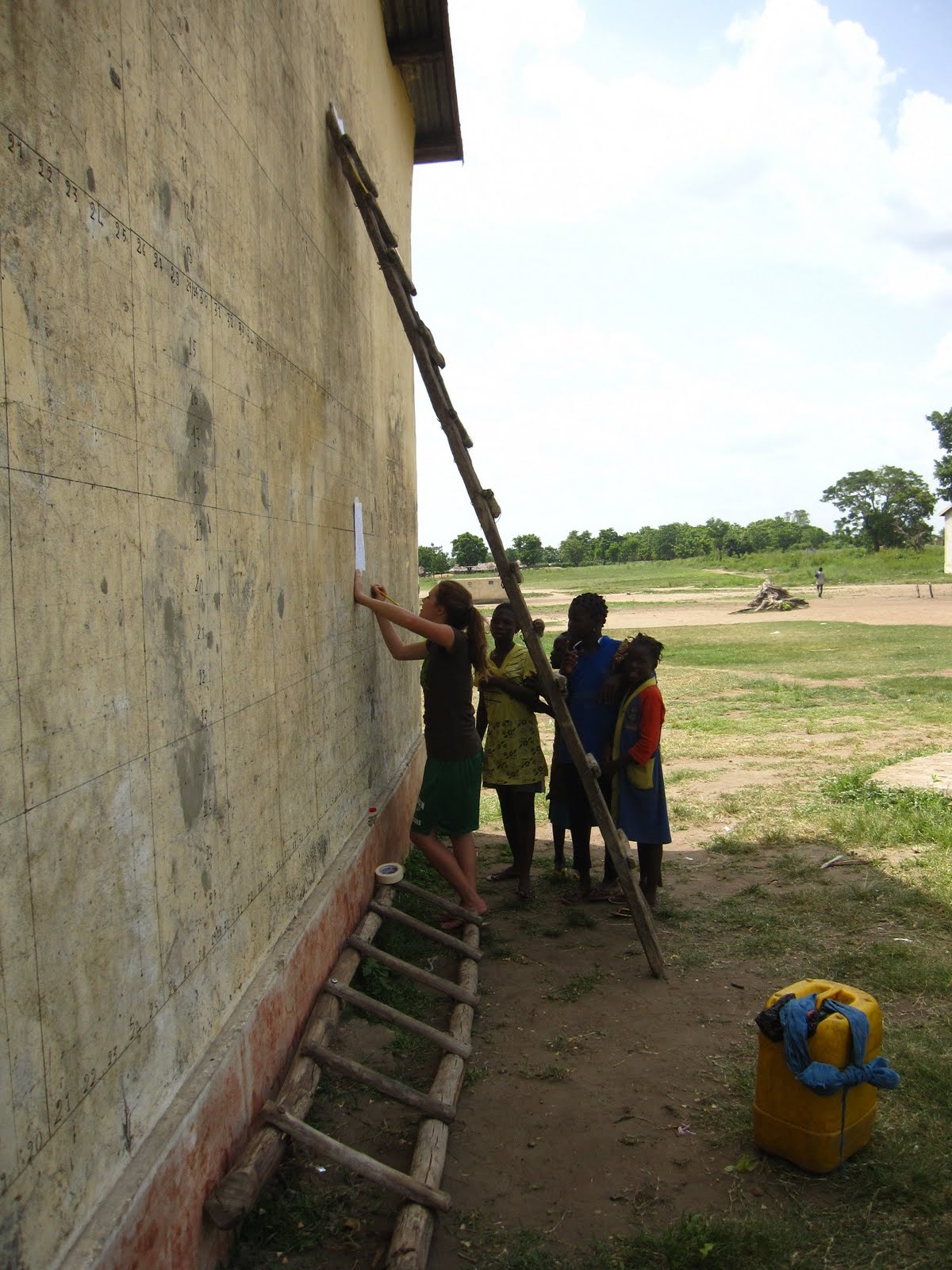
Hey everyone! This'll just be a quick update because I don't have a lot of new news, but I haven't written an entry in a while now...
Since Dad left at the beginning of June, I've been trying to adjust back to solitary life in village. I felt a little unfocused since I was in the States for most of May on vacation, and then Dad came out right afterwards, so I felt a strong need to be productive again, but the biggest adjustment I needed to make first was getting used to being alone again. I will say though, contrary to most warnings I got from people, it was not that difficult to come back to Togo after having gone back to the States. It was hard to say goodbye to everyone again, but the thing is, I don't currently have a place of my own in America; my house and my work and projects and current friends are all in Togo. So interestingly enough, I almost felt like I was actually away from "home" while in the States.
A new stage, or Peace Corps training class of volunteers, came in at the beginning of June, which kind of smacked me in the face with the reality that I only have just over one year left of service now. Time flies. It'll be really hard to say goodbye to all the volunteers who are ending their service this year, leaving in August, and being replaced by these new people.
Over the course of June, I've been focusing on a select few number of projects. I gave several expositions and sensibilizations on the importance of the Moringa tree in my village, and then successfully distributed about 150 of the trees that we (the middle school environmental club and I) planted back in April on Earth Day. I distributed them to students who sat in on the sensibilizations - the hope being that once they understand what an essential tree it is, they'll take good care of it. I also sent each kid home with one to give to a neighbor, instructing them to pass it on along with a verbal summary of what they now know about the tree. My goal is to eventually give a Moringa tree to most families in my village and equip them with the knowledge of its benefits.
My closest Peace Corps volunteer neighbor, Danielle and I have also been working hard organizing a training on sexual health for apprentices in our villages. Most apprentices have dropped out of school in order to devote all of their time to learning a profitable trade. The disadvantage to that is that they are therefore not exposed to information about different sexually transmitted illnesses, how one gets pregnant, the significance of the changes the body undergoes during adolescence, etc. So Danielle and I, with the help of some of homologues, organized an intensive 2-day training on the material; we went around to all of the ateliers, or workshops with apprentices, in each of our villages and selected the 2 most dynamic apprentices from each workshop. The idea is that after the selected adolescents are trained, they will go back to their ateliers and spread the message to the other apprentices - thereby serving as peer educators of sorts. We already did the training in Danielle's village last week, and it seemed to be very successful. The apprentices seemed very eager to learn all the material. The training in my village is scheduled for next week - and I'm a little more nervous about mine than I was hers because my training will have to be in local language (and so much information and effect and time is always lost in the process of translation), my homologues aren't quite as dynamic, and my kids are a little quieter too. But I'm hoping for the best.
I've also started planning a really big project for the end of August/ beginning of September based on a frustration I've developed over the fact that there are malnourished children of a number of women who've been coming to the baby-weighing sessions and have not shown much improvement (i.e. gained a satisfactory amount of weight) for months now. It's always a difficult situation for me on Thursdays, when we do the baby-weighing at my dispensaire, because there are usually so many women, and then there's the language barrier (the midwife and nurse are usually in the other room doing vaccinations, so I'm usually on my own), so I don't have the time or ability to convey detailed messages to the mother concerning what she must do to get her baby to achieve a healthy weight. And then sometimes, even when I do do that, the mother will give me an understanding nod to appease me, but then she'll go home and do nothing. It's that same frustrating fact I always allude to that I can only do so much, and then it's all in their hands. But I came up with the idea to do a training over the course of several meetings per week for a month with the mothers of all these consistently malnourished babies. The way it would hypothetically work would be that 3 times a week for 2 hours or so, we would all meet together and actually cook a nutritious meal to give them a demonstration of the type of food they should be feeding their child. While the food is cooking, I, with the help of some homologues and a maman lumiere (a mother in the same socioeconomic status as the rest of the mothers with healthy living habits and a healthy child - i.e. a model mother) would give one sensibilization per day on subjects such as the importance of hygiene, what to do when a child has diahrrea, the essential food groups that must be incorporated into a child's diet, etc. etc. The children are also weighed at the beginning and end of the month-long training, and the hope is that, if the mothers start incorporating the information into their behaviors at home, the child will ultimately show an improvement in weight by the end of the training. It's an opportunity to finally give exclusive attention to the women who are obviously struggling to support the health of their children. I'm really excited about the potential for success with this project, but I still have a lot of planning and work that needs to go into the organization first before this can all get pulled together.
So that's what I've been working on, and I've been glad to feel busy again. My boyfriend Dave is coming out in 2 days for a month, so I'm really excited about that too. He'll be bringing me a replacement camera so hopefully by the next entry I'll be able to post pictures again too.
Tuesday, June 30, 2009
Thursday, June 4, 2009
Dad's Visit
From May 5 - May 21, I went home to the States for a brief vacation! I had a blast but unfortunately lost my camera during the trip, so I can't post any pictures from the trip or from the several weeks in Togo just prior to leaving. However, a few days after arriving back in Togo, my Dad came for a 10-day visit. Thanks to the use of his camera, I've been able to post some pictures from his trip.
Dad's first day in Togo; a picture of us in front of the Peace Corps headquarters in Lome.
Taking a nap at the hotel, exhausted from the long trip and the heat.
Fabiola and me at the Grand Marche in Lome. This is my last picture with Fabiola before she ended her service this past week :(
On the way to Notse with some other volunteers for a Peace Corps organized festival advertising the benefits of the Moringa tree to local Togolese (Dad's first bush taxi ride)

Arriving at the hotel in Notse.
Setting up the charcoal at my booth for my presentation on the transformation of Moringa seeds into oil.
Grinding the Moringa seeds
Kids' Corner

Unloading Moringa trees to sell
Moringa advertisement poster
Moringa parade
Explaining oil transformation to interested Togolese
me and Dad!
Teaching the Togolese how to play musical chairs
Our audience
View of the marche from Dad's and my hotel room in Notse
Breakfast of bouillie the morning we left Notse
Gas station - bush taxi style
Walking to the Atakpame Peace Corps transit house with some other volunteers on the way back to village
Hanging out/Talking on the phone at the transit house

Dad and the little friends he made on the way to the Atakpame marche
Stocking up on vegetables - because I can't get them in village!

street food lunch
Dad's first moto-taxi ride in Togo - the last leg of the trip before we finally got to my village
nap time at my house
On the way to visit Danielle (that's me on the moto up ahead)
Chez Danielle
Touring Elavagnon (Danielle and Dad)
Now that rainy season is starting, Danielle and I wanted to try planting a vegetable garden. Dad helped plant.
Dad drawing water from the well
Dad and his favorite part of my village: the pigs

Visiting the school where I teach during the school year

The mill outside my house
Cooking and eating dinner - courtesy of the self-timer feature (The sign on my wall in the above picture is the sign Danielle made and put up for my arrival back in Togo - it was really sweet)

Dad's first taste of Tchouk (the local beer)
We went to the fields to show Dad what that's like. On the way we crossed paths with some Fulani cows being herded off to the market to be sold.
At the fields
Helping my host family plant peanuts

We stopped by one of my village neighbor's houses on the way back from the fields because he wanted to show off the skin he had kept from an alligator he caught

Dad watching pigs eat scraps I threw in the bushes
Playing with American toys!!
Laundry time
Thursday baby weighing

I still love holding babies!
Friday, April 24, 2009
Torn
A storm was coming. Lightning was illuminating the cumulonimbus clouds every few seconds as they rolled in faster and faster with the increasing wind. I was in the thatch-roofed cooking hut with 10 year-old Solim, who was at work making dinner - the usual meal of pate (corn and manioch flour boiled and stirred into a consistency similar to that of play-dough). The hut was dimly lit by a lantern hanging on a nail on the wall, but Solim had propped a weak flashlight between her cheek and shoulder to better see into the pot as she used both hands to stir with a wooden spoon half her size. She was thinking about and calculating out loud the difference in our ages: 23 and 10. We had just been talking about birthdays; as is the case with the majority of children in the village, she doesn't know her exact birthday - only that she was born on a Wednesday (the Togolese use the days of the week to determine the name of their children), and that sometime this year, she will turn 11. Outside, a handful of men were wandering into the compound, weary and still dressed from their all-day work in the fields. Now that it has started raining regularly again, everyone is hurrying to plant their fields of corn. The sooner you plant, the sooner it grows, and the sooner you can sell it for money. But the rush can mean taking a risk; if you plant your fields immediately after the first rain of the season, but then it doesn't rain again for a while, you could waste an entire crop - and that's a serious consequence for someone whose main source of income comes from the yield of their fields. I don't know a single farmer who doesn't immediately go get a drink upon arriving home from the fields. Even the threatening storm couldn't keep these men from crowding into my host mom Edwige's one-room boutique to take a shot or two of Sodabi - the local equivalent to vodka.
"So that means, when you were 13 years old, I was born!" Solim said triumphantly with a grin.
"That's right," I confirmed. "Now see if you can calculate what years we were each born in," I challenged. But right then we were interrupted by shouts from outside. Solim and I looked at each other and then jumped up and sprinted out of the hut to see what was going on. The wind had really picked up by now and was whipping sand into the air. I squinted and tried to shield my eyes with my hand to see. Then I saw him and my heart started pounding. He was dressed in a light grey suit and was moving slowly, putting one foot just in front of the other, heading directly for my porch. The way the light from the flashlights of the shouting men illuminated his suit made him look like a ghost. He stopped about 5 feet from my porch gate but still refused to turn and face the men and Edwige, who were quickly approaching and yelling at him in Kabiye.
I mentioned in my last entry that, only recently, I'd started having problems with this village fou, who was coming and hanging out on my porch during the days. It was a little annoying, but he seemed harmless - just a little crazy is all. Edwige or somebody would usually chase him away right away. Truthfully, I felt sorry him. As the story goes, he had been a student and was going to enter his last year in high school when, after coming back from summer vacation with his Dad in the north, he started acting differently and was never the same since. He only continued to spiral downward, affected by an undiagnosed mental illness. He's my age.
So I pitied him more than anything. But then he started stealing stuff from my porch. Everything was retrieved and he was forbidden to come back again, but he kept returning anyways. The first time I really began to feel anxious about his visits was when one day he showed up and no one else was in the compound and all of my neighbors were at their fields. As harmless as I believed him to be, I realized that if he did try anything, no one would be around to help me. After that visit, he was seriously warned by members of the village who were intervening on my behalf - and with the support of his parents- that if he showed up one more time, he would be gravely beaten.
And yet here he was again. I don't know if my heart was beating fast out of fright for wondering what his true intentions are for coming back again, or out of anxiety from seeing Edwige break off a large branch from a tree and hand it to the burly mason who then advanced quickly towards the fou. I knew what was coming.
Bolts of lightning were tearing across the sky directly above us now. I couldn't help but feel as if I was in the middle of a scene from a horror movie. The mason stopped only inches away from the fou's face and, yelling, waved the big stick above his head, but the fou didn't budge. The mason then pressed the stick against the fou's chest and pushed it hard enough that the fou stumbled back a couple steps before regaining his balance and planting his feet firmly against the ground again. That was it; the mason raised the stick high and, with a loud crack, brought it down hard against the fou's chest.
I immediately cringed and turned away, hearing myself whimper. I could not for the life of me understand the entertainment that the crowding observers saw in the beating that followed. I turned to look again only when I heard loud shouts from the crowd. The fou had started fighting back! Now, I can barely handle fight scenes in movies much less in real life. I was on the verge of tears.
The fou was so strong that he was beginning to gain advantage over the mason, so other men now jumped in. The fou was wrestled to the ground, and his arms were pinned behind his back. One of the men grabbed the stick and brought it down twice on the fou's face. Horrified, I turned away again, praying that this would all just end. The women were rushing about trying to take down part of the clothesline to use to tie the fou up.
Right then, a big drop of rain fell on my nose. It was followed by another - and then another. And then the rain started coming down in sheets. Solim and I rushed to take everything in from outside and put it under cover. In all my haste, I lost track of what was going on with the fight. It was only 10 minutes later, when I was catching my breath under the shelter of the porch in front of Edwige's boutique, that I saw the dim lantern light over under the gazeebo about 10 meters away, where everyone seemed to be seated. I couldn't see where they'd put the fou. Then the lightning lit up the sky and the compound and I gasped; the fou was standing outside under the pouring rain, his arms tied behind his back with a rope whose other end was tied to the wooden pole of the clothesline. "Are they forcing him to stand outside in the rain?" I exclaimed angrily. Solim looked up from the cuvette of freshly prepared local tchouk drink that she was in the process of filtering and sucked her teeth as an expression of disapproving confirmation. "They've already beat him, and now they're going to make him sick too?" I was furious from the inhumanity I saw in the situation. But a wall of rain separated me from the people to whom I felt I needed to express my feelings that this was going too far. Suddenly, one of the men emerged from the downpour, on his way into the boutique. I yelled my concern to him as he passed, and, half drunk from the shots he'd taken before the whole incident, he only scolded back, "He could have been trying to kill you and you're worried about the rain?"
"But he wasn't trying to kill me!" I shouted back, irritated by the exaggeration, as he disappeared into the boutique. But my voice was lost to the thundering rain on the tin roof.
The rain finally let up and the fou was escorted back to his house where, I later found out, he was thrown and locked in his room for who knows how long. He hasn't come back to visit me since, which the Togolese who helped me find a triumph, but everytime I ask about whatever happened to him, my question is dismissed with a wave of the hand - as if I'm ridiculous for even still considering him. After the incident, whenever I tried to express my disapproval over leaving him in the rain, I received laughter as a response. "He deserved it," the Togolese would say, and then smile into the distance, as if recalling the 'luck' they interpreted the storm to be in contributing to the punishment they gave him. Even Edwige, who I normally find so understanding, wasn't sympathetic. If she and I couldn't see eye to eye on this issue, how much further, I realized, I was from being on the same page as the rest of the community.
Even using story form, I find it difficult to express exactly what my emotions are regarding this whole event. It was, hands down, one of the more horrible things I've witnessed since coming to Togo. It was a situation in which I felt completely torn. On one hand, I was being being protected by my village. To complain too much about their approach would be interpreted as an insult to their help. On the other hand, while I did appreciate their act of intervention, I did not agree with the way they treated the fou, whose case, complicated by his mental state, only I seemed to consider as delicate. Even if I did say something, convincing the others of the basis of my plea seemed hopeless; I'm just the naive American who doesn't understand how things work in Africa.
I felt utterly helpless.
"So that means, when you were 13 years old, I was born!" Solim said triumphantly with a grin.
"That's right," I confirmed. "Now see if you can calculate what years we were each born in," I challenged. But right then we were interrupted by shouts from outside. Solim and I looked at each other and then jumped up and sprinted out of the hut to see what was going on. The wind had really picked up by now and was whipping sand into the air. I squinted and tried to shield my eyes with my hand to see. Then I saw him and my heart started pounding. He was dressed in a light grey suit and was moving slowly, putting one foot just in front of the other, heading directly for my porch. The way the light from the flashlights of the shouting men illuminated his suit made him look like a ghost. He stopped about 5 feet from my porch gate but still refused to turn and face the men and Edwige, who were quickly approaching and yelling at him in Kabiye.
I mentioned in my last entry that, only recently, I'd started having problems with this village fou, who was coming and hanging out on my porch during the days. It was a little annoying, but he seemed harmless - just a little crazy is all. Edwige or somebody would usually chase him away right away. Truthfully, I felt sorry him. As the story goes, he had been a student and was going to enter his last year in high school when, after coming back from summer vacation with his Dad in the north, he started acting differently and was never the same since. He only continued to spiral downward, affected by an undiagnosed mental illness. He's my age.
So I pitied him more than anything. But then he started stealing stuff from my porch. Everything was retrieved and he was forbidden to come back again, but he kept returning anyways. The first time I really began to feel anxious about his visits was when one day he showed up and no one else was in the compound and all of my neighbors were at their fields. As harmless as I believed him to be, I realized that if he did try anything, no one would be around to help me. After that visit, he was seriously warned by members of the village who were intervening on my behalf - and with the support of his parents- that if he showed up one more time, he would be gravely beaten.
And yet here he was again. I don't know if my heart was beating fast out of fright for wondering what his true intentions are for coming back again, or out of anxiety from seeing Edwige break off a large branch from a tree and hand it to the burly mason who then advanced quickly towards the fou. I knew what was coming.
Bolts of lightning were tearing across the sky directly above us now. I couldn't help but feel as if I was in the middle of a scene from a horror movie. The mason stopped only inches away from the fou's face and, yelling, waved the big stick above his head, but the fou didn't budge. The mason then pressed the stick against the fou's chest and pushed it hard enough that the fou stumbled back a couple steps before regaining his balance and planting his feet firmly against the ground again. That was it; the mason raised the stick high and, with a loud crack, brought it down hard against the fou's chest.
I immediately cringed and turned away, hearing myself whimper. I could not for the life of me understand the entertainment that the crowding observers saw in the beating that followed. I turned to look again only when I heard loud shouts from the crowd. The fou had started fighting back! Now, I can barely handle fight scenes in movies much less in real life. I was on the verge of tears.
The fou was so strong that he was beginning to gain advantage over the mason, so other men now jumped in. The fou was wrestled to the ground, and his arms were pinned behind his back. One of the men grabbed the stick and brought it down twice on the fou's face. Horrified, I turned away again, praying that this would all just end. The women were rushing about trying to take down part of the clothesline to use to tie the fou up.
Right then, a big drop of rain fell on my nose. It was followed by another - and then another. And then the rain started coming down in sheets. Solim and I rushed to take everything in from outside and put it under cover. In all my haste, I lost track of what was going on with the fight. It was only 10 minutes later, when I was catching my breath under the shelter of the porch in front of Edwige's boutique, that I saw the dim lantern light over under the gazeebo about 10 meters away, where everyone seemed to be seated. I couldn't see where they'd put the fou. Then the lightning lit up the sky and the compound and I gasped; the fou was standing outside under the pouring rain, his arms tied behind his back with a rope whose other end was tied to the wooden pole of the clothesline. "Are they forcing him to stand outside in the rain?" I exclaimed angrily. Solim looked up from the cuvette of freshly prepared local tchouk drink that she was in the process of filtering and sucked her teeth as an expression of disapproving confirmation. "They've already beat him, and now they're going to make him sick too?" I was furious from the inhumanity I saw in the situation. But a wall of rain separated me from the people to whom I felt I needed to express my feelings that this was going too far. Suddenly, one of the men emerged from the downpour, on his way into the boutique. I yelled my concern to him as he passed, and, half drunk from the shots he'd taken before the whole incident, he only scolded back, "He could have been trying to kill you and you're worried about the rain?"
"But he wasn't trying to kill me!" I shouted back, irritated by the exaggeration, as he disappeared into the boutique. But my voice was lost to the thundering rain on the tin roof.
The rain finally let up and the fou was escorted back to his house where, I later found out, he was thrown and locked in his room for who knows how long. He hasn't come back to visit me since, which the Togolese who helped me find a triumph, but everytime I ask about whatever happened to him, my question is dismissed with a wave of the hand - as if I'm ridiculous for even still considering him. After the incident, whenever I tried to express my disapproval over leaving him in the rain, I received laughter as a response. "He deserved it," the Togolese would say, and then smile into the distance, as if recalling the 'luck' they interpreted the storm to be in contributing to the punishment they gave him. Even Edwige, who I normally find so understanding, wasn't sympathetic. If she and I couldn't see eye to eye on this issue, how much further, I realized, I was from being on the same page as the rest of the community.
Even using story form, I find it difficult to express exactly what my emotions are regarding this whole event. It was, hands down, one of the more horrible things I've witnessed since coming to Togo. It was a situation in which I felt completely torn. On one hand, I was being being protected by my village. To complain too much about their approach would be interpreted as an insult to their help. On the other hand, while I did appreciate their act of intervention, I did not agree with the way they treated the fou, whose case, complicated by his mental state, only I seemed to consider as delicate. Even if I did say something, convincing the others of the basis of my plea seemed hopeless; I'm just the naive American who doesn't understand how things work in Africa.
I felt utterly helpless.
Saturday, April 18, 2009
Happy Spring!
The end of March marked the end of the second trimester at the local middle school. It was finished off by what Togo nationally celebrates as "cultural week" - a week during which the students performed the traditional dances of various ethnic groups (my village is a good mix of at least 6 major Togolese ethnic groups), held a number of soccer matches, played numerous games and activities, and organized a picnic and dance (which scarily reminded me exactly of high-school dances in the States- except now I was one of those creepy teacher supervisors on the side). It was a fun little break and interesting for me to participate in though, in spite of the pre-scheduled time schedule for the events, everything panned out on "l'heure africaine" (African time). Translation: nothing started any earlier than two hours late, which unfortunately ended up negatively affecting some of the sensibilizations I was scheduled to give a few times that week. The American that I am, I showed up at precisely the scheduled time for each event - but with a book, as I anticipated this would happen. I've become very good at waiting.
After cultural week was "spring break", which ended the Tuesday after Easter. For Easter weekend, I went down to Kpalimé with a number of other volunteers for a fake traditional Togolese wedding between 2 Peace Corps volunteers who had started dating at the beginning of their service. It was all just for fun, although it's hard to say if all the host moms who came didn't think it was real - even though I'm pretty sure they were informed. In any case it was really fun to see a bunch of volunteers who I rarely get to see and my host family from stage (training) as well. My host mom was so excited to see me that she immediately ran out and got a whole bag of oranges and made a fresh jar of peanut butter for me as a gift. The wedding was on Saturday, and the next day, Sunday, was Easter. I spent most of the day crammed in a bush taxi with other volunteers heading back towards village, so, for the first time in my life, I didn't get to go to an Easter church service. I missed it. The closest thing I came to a sunrise service was at the street-side rice and bean shack where we were all grabbing breakfast; a couple other volunteers and I were reminiscing about Easter services/celebrations back in the States, and we were all trying to remember the traditional Easter hymns and then belt out as many verses as we could recall - usually dissolving into laughter at the end because we couldn't usually remember much past the first verse of any of the hymns, and because all of our off-key voices together didn't sound too great. I think we may have annoyed the rice and beans guy but, I have to admit, it was nice.
The most eventful parts of this past week were my numerous encounters with one of the village "fou"s ("fou" is the French word for "crazy", and the title the Togolese use for the mentally ill, who are not usually institutionalized due to a lack of facilities in Togo). This particular "fou" is about my age (I'm not sure but I think he's schizophrenic) and, all of the past week, decided to hang out on my porch and refuse to leave. After the family in my compound chased him away with a stick so many times, he seemed to become aggravated and to "punish me", made off with my running shoes, which I always leave out on my front porch. He then proceeded to wear the shoes around village for 2 days, locking himself in his room with them whenever anyone went after him to retrieve them. Finally, some young men were able to successfully tackle him to the ground and remove the shoes by force. Due to his various other (failed) attempts to steal other items of mine, such as my bike and cell phone, and his refusal to obey to stay away from my house, the village people have decided to punish him with a good beating. Needless to say, I am not very pleased with this decision, but I am at a loss for any other effective solution. I have to say though, it is was really nice to see so many village members intervene on my behalf; it was a true testament to how well small villages take care of their volunteers.
I'm in Atakpamé this weekend because Peace Corp's bike mechanic, Paul, is passing through all the major villages in Togo (as he does twice a year) to fix up any bikes that volunteers bring by. My bike gets a lot of use and was in need of a good tune-up and a few reparations, so I rode it in for that purpose (if ever anything goes wrong with your bike in Togo, the worst idea ever is to take it to a local mechanic; they take a hammer to it in effort to fix it, so Paul's services are highly valued and appreciated). I'll be biking back to village this afternoon, though I'm not looking forward to it too much because I've picked something up and am having intestinal problems again - something I'm very used to by now but which is nevertheless still annoying as it always interferes with planned activities.
I'm getting excited because in only two and a half weeks now, I'll be on a plane headed for the States for a 2 week vacation to see my boyfriend, family, friends, and my sister Laura's graduation from college! I can't wait!
After cultural week was "spring break", which ended the Tuesday after Easter. For Easter weekend, I went down to Kpalimé with a number of other volunteers for a fake traditional Togolese wedding between 2 Peace Corps volunteers who had started dating at the beginning of their service. It was all just for fun, although it's hard to say if all the host moms who came didn't think it was real - even though I'm pretty sure they were informed. In any case it was really fun to see a bunch of volunteers who I rarely get to see and my host family from stage (training) as well. My host mom was so excited to see me that she immediately ran out and got a whole bag of oranges and made a fresh jar of peanut butter for me as a gift. The wedding was on Saturday, and the next day, Sunday, was Easter. I spent most of the day crammed in a bush taxi with other volunteers heading back towards village, so, for the first time in my life, I didn't get to go to an Easter church service. I missed it. The closest thing I came to a sunrise service was at the street-side rice and bean shack where we were all grabbing breakfast; a couple other volunteers and I were reminiscing about Easter services/celebrations back in the States, and we were all trying to remember the traditional Easter hymns and then belt out as many verses as we could recall - usually dissolving into laughter at the end because we couldn't usually remember much past the first verse of any of the hymns, and because all of our off-key voices together didn't sound too great. I think we may have annoyed the rice and beans guy but, I have to admit, it was nice.
The most eventful parts of this past week were my numerous encounters with one of the village "fou"s ("fou" is the French word for "crazy", and the title the Togolese use for the mentally ill, who are not usually institutionalized due to a lack of facilities in Togo). This particular "fou" is about my age (I'm not sure but I think he's schizophrenic) and, all of the past week, decided to hang out on my porch and refuse to leave. After the family in my compound chased him away with a stick so many times, he seemed to become aggravated and to "punish me", made off with my running shoes, which I always leave out on my front porch. He then proceeded to wear the shoes around village for 2 days, locking himself in his room with them whenever anyone went after him to retrieve them. Finally, some young men were able to successfully tackle him to the ground and remove the shoes by force. Due to his various other (failed) attempts to steal other items of mine, such as my bike and cell phone, and his refusal to obey to stay away from my house, the village people have decided to punish him with a good beating. Needless to say, I am not very pleased with this decision, but I am at a loss for any other effective solution. I have to say though, it is was really nice to see so many village members intervene on my behalf; it was a true testament to how well small villages take care of their volunteers.
I'm in Atakpamé this weekend because Peace Corp's bike mechanic, Paul, is passing through all the major villages in Togo (as he does twice a year) to fix up any bikes that volunteers bring by. My bike gets a lot of use and was in need of a good tune-up and a few reparations, so I rode it in for that purpose (if ever anything goes wrong with your bike in Togo, the worst idea ever is to take it to a local mechanic; they take a hammer to it in effort to fix it, so Paul's services are highly valued and appreciated). I'll be biking back to village this afternoon, though I'm not looking forward to it too much because I've picked something up and am having intestinal problems again - something I'm very used to by now but which is nevertheless still annoying as it always interferes with planned activities.
I'm getting excited because in only two and a half weeks now, I'll be on a plane headed for the States for a 2 week vacation to see my boyfriend, family, friends, and my sister Laura's graduation from college! I can't wait!
Monday, March 23, 2009
Behavior change - for myself
Ever since I was young, I have 1) been a perfectionist, and 2) liked being in control of things. In certain situations, these characteristics have helped me succeed; in other situations , (by my own fault) they have only brought me frustration, stress, and tension between myself and others. And sometimes the answer to the question of whether or not these characteristics of mine have been a good thing or not isn't quite black or white; it depends on the perspective. For example, when working on team projects in high school, I can think of a number of times when I'd insist on taking on more than my alotted share of work - not just to be chivalrous, but because I felt that if I was in charge of a large portion of the work, I could be more in control of what the outcome would be. And being a perfectionist meant that I'd often end up putting more time and effort into an aspect of the project than any other reasonable person might have. But it generally resulted in an impressionable product. One could argue that the usually good final grade made all that anal behavior a good thing. But then again, I hadn't been a very good team player, had I?
Do you see what I mean?
Being dropped off in a village by myself in the middle of Togo and told that I could work on or start whatever project I deemed necessary on my own timeline thrilled me. Having the freedom to do what I want, when I want, to the extent I want struck me as a perfect match for my particular characteristics, and I envisioned amazing results in store for the future. Until I was smacked awake with the reality that accomplishing Peace Corp's greatest goal - 'sustainable development' - has far less to do with me alone than I was anticipating. You see, the thing about mobilizing a community and bringing about behavior change is that you can run around and educate and sensibilize and organize projects, but at the end of the day, if you don't get a response from the people you're working with or if they aren't quite motivated enough, nothing will happen. It's the same idea as running a relay race; you can put your everything into your sprint and run your heart out, but if, when you pass the baton off to the next receiver, the person just stands there, then nothing evolves. The finish line can't be crossed because of your efforts alone.
I'll give you a very basic, small-scale example of this. I recently organized a community-wide celebration for World Women's Day, including a parade with people wearing the same 'uniform', dancing, speeches, skits, and a dinner at the chief's house. For the skits, I tried organizing two - one performed by the village women, and one performed by some middle school kids. Let me preface by saying that trying to organize Togolese to meet a number of times to practice something is no easy task. The students were not as punctual or reliable as they promised to be, but they were far better than the women, who, if showed up at all to the meetings, were NEVER earlier than 3 hours late. Still I put SO much time, money, and effort into gong-gonging (organizing a man to go around the entire village at 4 AM in the morning and yell the announcement for the meeting; that's how you notify people in these small villages with no media), planning meetings, helping the women come up with ideas for what to present and how to organize the day, preparing food, etc. etc. etc... Anyways, using the women's skit as a small example - in spite of practicing and everything, last minute (and I mean - I was on stage announcing their performance), the women decided they didn't want to do it. Now, as annoying as that was, it was nothing - it was just a skit. But it's the idea I'm talking about; I did everything I could to help them, but when it was left fully in their hands, they ended up deciding not to do anything, and that was that.
The concept of it all seems so obvious, doesn't it? One person can make a difference, but it involves more than just that one person. But it's hard to really come to terms with at first, because you enter into this tiny community in this remote village as a celebrity - literally. Villagers pay attention to you; they notice and watch you wherever you go, and if you start speaking, they'll approach you to hear what you have to say. And so it's easy to initially get caught up with the boastful thought that you can easily transform a community single-handedly.
I now laugh at myself for my initial, naive pride. But don't get me wrong - I'm not a total pessimist now, thinking, "what's the point in even trying?" No, not at all. Because sometimes someone does listen and does act accordingly. It can be rare, but when it happens, it's the most satisfying part of this job. I would say I have become much more realistic though. This is one of those situations in which I have to suck it up and admit that I just can't take full control of this project; I won't accomplish diddly-squat long term if I try to take on all the work myself. Because the point of this whole deal is not what was finished by the end of my service; it's what continues on after I'm gone.
So what does that mean for my current projects and approach to things? Well, most importantly, I'm learning to be a better team player. I've learned the importance of having homologues in everything I do, because if they see and learn from what I do, they (hopefully/ideally) will continue after I leave. For example, this past year, I alone taught my girl's club. Next year, I'm planning on turning it into a peer educator's club (to include boys, as I've come to realize how many are actually interested) and having a co-teacher, which will hopefully provide sustainability, but which I anticipate should also improve attendance, decrease tardiness, and ameliorate scheduling with other teachers. Peace Corps did stress the importance of having a homologue in everything from the beginning, but I was a tough, independent control-freak nut to crack. I'm just glad, now that I've eaten some humble pie and learned important lessons first-hand, I have a whole nother year to improve; 2 years of service makes a whole lot more sense to me now.
Smart thinking, Peace Corps. You anticipated having stubborn people like me.
______________
RECENT (not terribly exciting or but nevertheless) PICTURES!
Emily (grossed out) trying to remove the lizard that her cat decapitated and then brought into her house.
These are the ridiculous helmets we are required (but I'm more than happy) to wear when riding motorcycles in village. This picture was taking at Emily's house - aka: The menagerie.
This is the solar oven Danielle and I made out of scrap wood, a mirror, a piece of glass, cardboard from care packages, foil, and LOTS of duct tape. It's a work in progress; we're currently trying to make improvements to it to improve it's effectiveness.
This picture was taken the day after Fabiola's birthday party, which we celebrated at Emily's house. We gathered together a bunch of trashy girly magazines that we'd received in care packages and indulged in new celebrity gossip; it's kind of disturbing how enthralled we were, but hey - it's something from America!
I love this picture. That girl is the 2 year-old daughter of one of my landlady's seamstress apprentices. She's such a ham. That dog was praying for a piece of dropped breakfast and Solim was teasing him.
The start of the gathering for the parade for World Women's Day
Dancing after the parade
The drummers
I made a little introductory speech in Kabiye!

The chief of my village giving his speech.
The middle school kids' skit. They were so cute.
I was a little disappointed with World Women's Day as it didn't quite live up to my expectations, but the women definitely enjoyed it at least. This picture was taken the next day when they came over (still in their 'uniforms') to thank me for organizing the celebration. It was very sweet of them to do. *Note: they brought that big bucket over just as a prop for the picture - there was nothing in it.
Sorry - this isn't a picture for those of you who are queezy - or animal rights activists. This is a picture of the neighbor cutting up fresh meat for lunch for the men. I was interested in watching until I realized it was the family dog.
It's avocado season now so on Emily's last visit, we made homemade guacamole and corn tortilla chips for dinner. It was SO hot - we were sweating our brains out (I couldn't even handle clothes - I was just walking around in my shower pagne).

My favorite thing about Togolese babies? The mothers are more than happy to drop them in your lap and you can play with them as much as you want.
Solim - one of my favorite kids in village. She's such a little troublemaker.
Emma (my homologue/the midwife) giving a sensibilization at a baby-weighing session.
Do you see what I mean?
Being dropped off in a village by myself in the middle of Togo and told that I could work on or start whatever project I deemed necessary on my own timeline thrilled me. Having the freedom to do what I want, when I want, to the extent I want struck me as a perfect match for my particular characteristics, and I envisioned amazing results in store for the future. Until I was smacked awake with the reality that accomplishing Peace Corp's greatest goal - 'sustainable development' - has far less to do with me alone than I was anticipating. You see, the thing about mobilizing a community and bringing about behavior change is that you can run around and educate and sensibilize and organize projects, but at the end of the day, if you don't get a response from the people you're working with or if they aren't quite motivated enough, nothing will happen. It's the same idea as running a relay race; you can put your everything into your sprint and run your heart out, but if, when you pass the baton off to the next receiver, the person just stands there, then nothing evolves. The finish line can't be crossed because of your efforts alone.
I'll give you a very basic, small-scale example of this. I recently organized a community-wide celebration for World Women's Day, including a parade with people wearing the same 'uniform', dancing, speeches, skits, and a dinner at the chief's house. For the skits, I tried organizing two - one performed by the village women, and one performed by some middle school kids. Let me preface by saying that trying to organize Togolese to meet a number of times to practice something is no easy task. The students were not as punctual or reliable as they promised to be, but they were far better than the women, who, if showed up at all to the meetings, were NEVER earlier than 3 hours late. Still I put SO much time, money, and effort into gong-gonging (organizing a man to go around the entire village at 4 AM in the morning and yell the announcement for the meeting; that's how you notify people in these small villages with no media), planning meetings, helping the women come up with ideas for what to present and how to organize the day, preparing food, etc. etc. etc... Anyways, using the women's skit as a small example - in spite of practicing and everything, last minute (and I mean - I was on stage announcing their performance), the women decided they didn't want to do it. Now, as annoying as that was, it was nothing - it was just a skit. But it's the idea I'm talking about; I did everything I could to help them, but when it was left fully in their hands, they ended up deciding not to do anything, and that was that.
The concept of it all seems so obvious, doesn't it? One person can make a difference, but it involves more than just that one person. But it's hard to really come to terms with at first, because you enter into this tiny community in this remote village as a celebrity - literally. Villagers pay attention to you; they notice and watch you wherever you go, and if you start speaking, they'll approach you to hear what you have to say. And so it's easy to initially get caught up with the boastful thought that you can easily transform a community single-handedly.
I now laugh at myself for my initial, naive pride. But don't get me wrong - I'm not a total pessimist now, thinking, "what's the point in even trying?" No, not at all. Because sometimes someone does listen and does act accordingly. It can be rare, but when it happens, it's the most satisfying part of this job. I would say I have become much more realistic though. This is one of those situations in which I have to suck it up and admit that I just can't take full control of this project; I won't accomplish diddly-squat long term if I try to take on all the work myself. Because the point of this whole deal is not what was finished by the end of my service; it's what continues on after I'm gone.
So what does that mean for my current projects and approach to things? Well, most importantly, I'm learning to be a better team player. I've learned the importance of having homologues in everything I do, because if they see and learn from what I do, they (hopefully/ideally) will continue after I leave. For example, this past year, I alone taught my girl's club. Next year, I'm planning on turning it into a peer educator's club (to include boys, as I've come to realize how many are actually interested) and having a co-teacher, which will hopefully provide sustainability, but which I anticipate should also improve attendance, decrease tardiness, and ameliorate scheduling with other teachers. Peace Corps did stress the importance of having a homologue in everything from the beginning, but I was a tough, independent control-freak nut to crack. I'm just glad, now that I've eaten some humble pie and learned important lessons first-hand, I have a whole nother year to improve; 2 years of service makes a whole lot more sense to me now.
Smart thinking, Peace Corps. You anticipated having stubborn people like me.
______________
RECENT (not terribly exciting or but nevertheless) PICTURES!
Friday, February 27, 2009
RAIN!
I noticed the clouds rolling in on my way back from the market. "Rain would be nice ..." I thought as I wiped the sweat dripping from my face with my shirt sleeve. But I wasn't going to get my hopes up. It had been months now since we'd had any substantial rain in my village. I can think of 2 times when a rare drizzle had passed through, but - aside from those exceptions - I'd grown used to waking up everyday expecting nothing else but the usual weather forecast: sunny and hot.
Harmattan season was nice. It started in November and was marked by cool mornings and evenings (which the Togolese hated but I loved). Sometimes it would get so cool at night that I'd even need to sleep with a sheet. And some mornings the chill would linger long enough that my regular morning bucket bath (which was usually refreshing) would get me shivering and I'd have to throw on a sweatshirt and sweatpants until the water on the charcoal finished boiling and I could warm up with some hot bouillie. The rain stopped falling and the air became very dry, which was a nice break from the oppressive humidity. It was a glorious change of weather.
The one downside was the dust. Harmattan winds blew in dust from the Sahara, but days on end of a baking sun transformed our own soil too; the ground, which used to get packed down by rain every couple days, now became heated and dry and easily churned up when you walked on it. The slightest breeze would whip up a cloud of dust that would then inevitably find its way into your house and settle on your bedsheets and books and couches and floor. I couldn't go more than 2 days without sweeping and dusting my whole house - although even that didn't do much because sweeping would often just stir a lot of the dust up into the air before it'd settle right back where it started in just a couple of minutes. The roads turned into piles of pure sand, making biking very difficult, and contributing to more motorcycle accidents than I'd care to witness in a lifetime. Helmet-less moto drivers would wear nose and mouth masks and sunglasses to keep the dust from getting into their eyes, teeth, and lungs. But nothing could be done to keep the dust from settling on your skin - something that I think annoyed me more than the Togolese, mostly because it was much more noticeable on my white skin (it's always the most horrifying when sweat drips down and carves a trail in it, leaving streaks all over).
Harmattan seems to have ended now though, and the Togolese are starting to brace themselves for what they call the "real heat" that's supposedly coming in March and April. "You think this is bad ..." is the phrase that has to come to characterize the start of the warnings they offer me when they catch me fanning myself in the shade. The humidity has noticeably risen again, though rain (in its regularity) is still weeks away. I'm mostly wondering how in the world I'm going to sleep during this supposedly imminent, deathly heat wave considering how, even now, I'll wake up and stay awake for hours in bed, dripping with sweat, fanning myself with the same straw fan I use to fan my charcoal, praying for even the smallest breeze to blow through my window and break up the stale, 100 degree air that weighs down me in my poorly ventilated room. Even the mice in my ceiling seem to have grown lethargic with the heat, making much less noise these days than they used to. I'll lay there in bed, fantasizing, Bigger/more windows ... electricity and a fan ... just one rainshower to cool things down ...
Be careful what you wish for.
By dinnertime, lightning was lighting up the clouds in the distance, eventually becoming so frequent that it was like a strobe light, illuminating the sky every 2 seconds. And still I doubted. Heat lightning, I thought.
It was only after I got into bed that the wind started up, and then suddenly I heard it - the pitter patter of rain on the tin roof. I couldn't help but smile as I felt the temperature drop. I'll finally sleep comfortably tonight, I thought as I grabbed my sheet and rolled onto my side. A couple minutes passed and the rain and wind picked up, so much that raindrops were now traveling far enough through the screen on my window to touch my toes. I wondered for a second if I should shut the windows, but I dismissed the idea, thinking that the rain probably wouldn't last. And besides - I'd been meaning to mop anyways.
And then all of a sudden it was really coming down - or sideways really. The sound of the rain on the tin roof became deafening. I turned over in my bed and my feet landed with a squish on the foot of my mattress, which I realized, as I sat up with a start, had become sopping wet from the sideways rain. Annoyed, I grabbed my flashlight and turned it on, quickly realizing that my wet bed was the least of my worries considering a small lake of dirt (I hadn't swept for a while) had formed on the floor under my window and was creeping towards the center of my room.
"Oh, Great," I said out loud as I jumped out of bed (splash) and ran to check on the other room, where an even bigger dirt lake was waiting for me. My couch cushions were soaked and my coffee table books were dripping wet. It gets worse: that wall that faces the back of the house is made of mere clay with just a thin layer of plaster on the inside - meaning, it's not very waterproof. So water had actually soaked through the wall and was staining it in wet stripes. Under the window, the rain had puddled on the sill and was now streaming down the wall, dragging dirt with it. So much for my beautiful paint job, I groaned in my head (once dirt gets on these walls, you can't get it off unless you take the paint off with it).
I had to close the windows. To close them from the inside meant I had to take out all the little pieces of sponge that I'd stuffed in the cracks between the screen and the frame to keep lizards/mice/bugs from coming in - which was a huge hassle. But I did it, although the job first required putting my rainjacket on backwards to protect me from the now hail-like rain that was shooting through the window, and sloshing through the inch of rainwater that had collected on my floor. Before I could then open my screen, I had to slam my hand against the screen multiple times to force off the dozen lizards that were clinging to the other side (the screen opens inward, you see, and the last thing I wanted was for all those lizards to fall onto my floor and scurry around my house - wouldn't that be the icing on the cake?). Finally I was able to reach outside and pull the wooden shutters shut. I was absolutely soaked, my house was a disaster, and I was going to have to give up my morning plans to now mop up my inundated floor. I found myself suddenly laughing though; I had completely forgotten that this is what rain in Togo is like!
Tropical climate, anyone?


Harmattan season was nice. It started in November and was marked by cool mornings and evenings (which the Togolese hated but I loved). Sometimes it would get so cool at night that I'd even need to sleep with a sheet. And some mornings the chill would linger long enough that my regular morning bucket bath (which was usually refreshing) would get me shivering and I'd have to throw on a sweatshirt and sweatpants until the water on the charcoal finished boiling and I could warm up with some hot bouillie. The rain stopped falling and the air became very dry, which was a nice break from the oppressive humidity. It was a glorious change of weather.
The one downside was the dust. Harmattan winds blew in dust from the Sahara, but days on end of a baking sun transformed our own soil too; the ground, which used to get packed down by rain every couple days, now became heated and dry and easily churned up when you walked on it. The slightest breeze would whip up a cloud of dust that would then inevitably find its way into your house and settle on your bedsheets and books and couches and floor. I couldn't go more than 2 days without sweeping and dusting my whole house - although even that didn't do much because sweeping would often just stir a lot of the dust up into the air before it'd settle right back where it started in just a couple of minutes. The roads turned into piles of pure sand, making biking very difficult, and contributing to more motorcycle accidents than I'd care to witness in a lifetime. Helmet-less moto drivers would wear nose and mouth masks and sunglasses to keep the dust from getting into their eyes, teeth, and lungs. But nothing could be done to keep the dust from settling on your skin - something that I think annoyed me more than the Togolese, mostly because it was much more noticeable on my white skin (it's always the most horrifying when sweat drips down and carves a trail in it, leaving streaks all over).
Harmattan seems to have ended now though, and the Togolese are starting to brace themselves for what they call the "real heat" that's supposedly coming in March and April. "You think this is bad ..." is the phrase that has to come to characterize the start of the warnings they offer me when they catch me fanning myself in the shade. The humidity has noticeably risen again, though rain (in its regularity) is still weeks away. I'm mostly wondering how in the world I'm going to sleep during this supposedly imminent, deathly heat wave considering how, even now, I'll wake up and stay awake for hours in bed, dripping with sweat, fanning myself with the same straw fan I use to fan my charcoal, praying for even the smallest breeze to blow through my window and break up the stale, 100 degree air that weighs down me in my poorly ventilated room. Even the mice in my ceiling seem to have grown lethargic with the heat, making much less noise these days than they used to. I'll lay there in bed, fantasizing, Bigger/more windows ... electricity and a fan ... just one rainshower to cool things down ...
Be careful what you wish for.
By dinnertime, lightning was lighting up the clouds in the distance, eventually becoming so frequent that it was like a strobe light, illuminating the sky every 2 seconds. And still I doubted. Heat lightning, I thought.
It was only after I got into bed that the wind started up, and then suddenly I heard it - the pitter patter of rain on the tin roof. I couldn't help but smile as I felt the temperature drop. I'll finally sleep comfortably tonight, I thought as I grabbed my sheet and rolled onto my side. A couple minutes passed and the rain and wind picked up, so much that raindrops were now traveling far enough through the screen on my window to touch my toes. I wondered for a second if I should shut the windows, but I dismissed the idea, thinking that the rain probably wouldn't last. And besides - I'd been meaning to mop anyways.
And then all of a sudden it was really coming down - or sideways really. The sound of the rain on the tin roof became deafening. I turned over in my bed and my feet landed with a squish on the foot of my mattress, which I realized, as I sat up with a start, had become sopping wet from the sideways rain. Annoyed, I grabbed my flashlight and turned it on, quickly realizing that my wet bed was the least of my worries considering a small lake of dirt (I hadn't swept for a while) had formed on the floor under my window and was creeping towards the center of my room.
"Oh, Great," I said out loud as I jumped out of bed (splash) and ran to check on the other room, where an even bigger dirt lake was waiting for me. My couch cushions were soaked and my coffee table books were dripping wet. It gets worse: that wall that faces the back of the house is made of mere clay with just a thin layer of plaster on the inside - meaning, it's not very waterproof. So water had actually soaked through the wall and was staining it in wet stripes. Under the window, the rain had puddled on the sill and was now streaming down the wall, dragging dirt with it. So much for my beautiful paint job, I groaned in my head (once dirt gets on these walls, you can't get it off unless you take the paint off with it).
I had to close the windows. To close them from the inside meant I had to take out all the little pieces of sponge that I'd stuffed in the cracks between the screen and the frame to keep lizards/mice/bugs from coming in - which was a huge hassle. But I did it, although the job first required putting my rainjacket on backwards to protect me from the now hail-like rain that was shooting through the window, and sloshing through the inch of rainwater that had collected on my floor. Before I could then open my screen, I had to slam my hand against the screen multiple times to force off the dozen lizards that were clinging to the other side (the screen opens inward, you see, and the last thing I wanted was for all those lizards to fall onto my floor and scurry around my house - wouldn't that be the icing on the cake?). Finally I was able to reach outside and pull the wooden shutters shut. I was absolutely soaked, my house was a disaster, and I was going to have to give up my morning plans to now mop up my inundated floor. I found myself suddenly laughing though; I had completely forgotten that this is what rain in Togo is like!
Tropical climate, anyone?
Saturday, February 7, 2009
January Pictures and a reality update
As of January 21, I am now into my "teens" in terms of months of service left in Togo (down from 27 months to 19). I'm not counting down the days until I get out of here or anything, but it was just something that I realized. Sometimes when I think about it, I'm amazed that I've already finished 8 months, and then other days, I think "I still have so long to go!". Whenever I think of the time I have left in terms of work though, I always get anxious in feeling that it's not enough time to accomplish everything I want to get done. I guess that's the reality of development work: everything just goes so slowly.
In that vein, I have very dramatic ups and downs/highs and lows. I was re-reading some of my past blog entries and was thinking how they make me seem like I'm happy ALL the time - which isn't quite the case. That's not meant to be interpreted as: I wish I wasn't living here. I just mean to say that the reality is, behavior change comes about very slowly (if at all), and in the meantime, the kinds of issues I encounter in my work can sometimes be very difficult to deal with.
A couple examples:
-HIGH: I got really excited this one day when the mother of one of my neighboring families approached me about getting herself and her 15 year-old daughter on some method of birth control. I had been trying to talk to them both for a while about it because the Mom has 6 kids and is still fertile and could very easily get pregnant again, but doesn't want to, and yet isn't using protection. And the daughter had run away with a local boy at the beginning of the month to who-knows-where before finally coming back, and was now obviously sexually active, and the mom was terrified that she was going to get pregnant. After first discussing the options with the two of them and what the process would likely entail, I agreed to first accompany the daughter to the dispensaire as moral support.
LOW: It turned out that the girl already had an STD. Worse: after asking her questions about when the symptoms began, we found out that she'd contracted it in 2005 - which means she was 12. But there are no health classes here (even if there were, she'd dropped out of school anyways) so she didn't realize it was something abnormal, and moms don't talk to their daughters about these kinds of things (usually because they themselves don't even know!), and kids don't have physicals, etc. etc... So she just plain didn't realize. The second part of that morning thus involved me going back and sitting down with her mom and talking with them about the consequences of this and what her responsibilities are now to prevent her from spreading this to others (although the likelihood is that her current boyfriend is probably already infected), while in the back of my mind, I couldn't help from doubting that she was actually going to follow my advice. That incident alone depressed me for the remainder of the week.
-HIGH: Not long after arriving permanently at post, I met the director of the CEG (middle school) who was incredibly friendly and flexible and supportive of all of my projects. His support helped me get a lot of my initial projects underway.
LOW: A couple weeks ago, while meeting with him over work, he made completely inappropriate comments, suggestions, and gestures that proved himself to be just like the other men I know here who disrespect women. I had thought he was different but he wasn't. I was disappointed to the point of tears over that one.
-HIGH: In response to their complete ignorance/lack of knowledge about their bodies and puberty, etc., I started using my girls club sessions to talk about things like why girls get periods, how (biologically) a girl gets pregnant, what type of birth control exists and how they work, etc. I was really encouraged by the girls' reactions because they were completely enthralled and participated with a bunch of questions that they had never had the chance to ask before. They just plain didn't know! Some older girls (some of whom already had children) even later approached me about helping get them on birth control methods, now that they knew they existed.
LOW: When they realized that they had to consult with the midwife in the dispensaire rather then with me about what method to go on, their response was "Oh...Never mind". The problem (I realized)? The midwife has such a bad attitude and temper that girls do not want to approach her about getting put on a birth control method because she'll just YELL at them for being sexually active so young. And YES - being sexually active is obviously not the ideal life choice for these girls at their age, but - realistically - her yelling at them is not going to make them stop, and what instead happens is she scares them to the extent that they AVOID the dispensaire, and then they don't use ANYTHING, and then they get pregnant. This is a problem I am still trying to resolve.
There are also just a lot of other things I encounter all the time that are hard to deal with, including incredibly malnourished babies (the worst cases are the ones where the mothers don't seem to care), induced abortions (once a girl came in to the dispensaire with an infection that came about because she had tried to abort her pregnancy by sticking a bicycle wheel spoke up her vagina to burst the umbilical sac; I've also known girls who have died from trying to induce abortions by drinking homemade herbal mixes), EARLY pregnancies (once a tiny 13 year old girl came in to the dispensaire with her mom because she'd been throwing up and thought she had the flu; it turned out she was pregnant), and serious wounds (a woman once came in after having been attacked by her husband with a machete and had deep cuts all over her head and shoulders).
It's heavy stuff. And I'm so grateful for the experience and the chance to do what I can to help with the things that I can, but sometimes it can be really overwhelming! Thank you to those who serve as the people I vent to when I need to - I don't know how I'd make it otherwise! I am also grateful that my work here does involve as many highs as lows because it helps me to keep going.
--------------
NEW PICTURES!
Lizards cooling off on my window screen at night (this happens every night). Notice the blue foam stuffed around the sides of the window frame: I did this so that the lizards would stop coming INTO my house that way.

Making enriched bouille with girls from my girls club on the porch in my compound.

Some girls from my girls club selling enriched bouille at the market and showing off their new shirts (the club name is "Filles en Action" (Girls in Action) )
Danielle came back from her vacation in the States! Fabiola came and visited and we celebrated.
Danielle and I doing an Enriched Bouille sensibilization in a neighboring village


Baby-weighing at the dispensaire. The women weigh the babies on the scale on the left, and I record the weights along with demographic information in the babies' health books and in the dispensaire's record books.
Danielle and a HEALTHY baby at my baby-weighing
Me and the Pharmacist in the pharmacy at my dispensaire
Teaching my environmental class about the moringa tree
Starbucks Togo-Style; Emily and our home-made coffee cake
Emily and her new puppy, Fenway
In-Service Training; I hadn't seen a lot of these people from stage since swear-in!
In that vein, I have very dramatic ups and downs/highs and lows. I was re-reading some of my past blog entries and was thinking how they make me seem like I'm happy ALL the time - which isn't quite the case. That's not meant to be interpreted as: I wish I wasn't living here. I just mean to say that the reality is, behavior change comes about very slowly (if at all), and in the meantime, the kinds of issues I encounter in my work can sometimes be very difficult to deal with.
A couple examples:
-HIGH: I got really excited this one day when the mother of one of my neighboring families approached me about getting herself and her 15 year-old daughter on some method of birth control. I had been trying to talk to them both for a while about it because the Mom has 6 kids and is still fertile and could very easily get pregnant again, but doesn't want to, and yet isn't using protection. And the daughter had run away with a local boy at the beginning of the month to who-knows-where before finally coming back, and was now obviously sexually active, and the mom was terrified that she was going to get pregnant. After first discussing the options with the two of them and what the process would likely entail, I agreed to first accompany the daughter to the dispensaire as moral support.
LOW: It turned out that the girl already had an STD. Worse: after asking her questions about when the symptoms began, we found out that she'd contracted it in 2005 - which means she was 12. But there are no health classes here (even if there were, she'd dropped out of school anyways) so she didn't realize it was something abnormal, and moms don't talk to their daughters about these kinds of things (usually because they themselves don't even know!), and kids don't have physicals, etc. etc... So she just plain didn't realize. The second part of that morning thus involved me going back and sitting down with her mom and talking with them about the consequences of this and what her responsibilities are now to prevent her from spreading this to others (although the likelihood is that her current boyfriend is probably already infected), while in the back of my mind, I couldn't help from doubting that she was actually going to follow my advice. That incident alone depressed me for the remainder of the week.
-HIGH: Not long after arriving permanently at post, I met the director of the CEG (middle school) who was incredibly friendly and flexible and supportive of all of my projects. His support helped me get a lot of my initial projects underway.
LOW: A couple weeks ago, while meeting with him over work, he made completely inappropriate comments, suggestions, and gestures that proved himself to be just like the other men I know here who disrespect women. I had thought he was different but he wasn't. I was disappointed to the point of tears over that one.
-HIGH: In response to their complete ignorance/lack of knowledge about their bodies and puberty, etc., I started using my girls club sessions to talk about things like why girls get periods, how (biologically) a girl gets pregnant, what type of birth control exists and how they work, etc. I was really encouraged by the girls' reactions because they were completely enthralled and participated with a bunch of questions that they had never had the chance to ask before. They just plain didn't know! Some older girls (some of whom already had children) even later approached me about helping get them on birth control methods, now that they knew they existed.
LOW: When they realized that they had to consult with the midwife in the dispensaire rather then with me about what method to go on, their response was "Oh...Never mind". The problem (I realized)? The midwife has such a bad attitude and temper that girls do not want to approach her about getting put on a birth control method because she'll just YELL at them for being sexually active so young. And YES - being sexually active is obviously not the ideal life choice for these girls at their age, but - realistically - her yelling at them is not going to make them stop, and what instead happens is she scares them to the extent that they AVOID the dispensaire, and then they don't use ANYTHING, and then they get pregnant. This is a problem I am still trying to resolve.
There are also just a lot of other things I encounter all the time that are hard to deal with, including incredibly malnourished babies (the worst cases are the ones where the mothers don't seem to care), induced abortions (once a girl came in to the dispensaire with an infection that came about because she had tried to abort her pregnancy by sticking a bicycle wheel spoke up her vagina to burst the umbilical sac; I've also known girls who have died from trying to induce abortions by drinking homemade herbal mixes), EARLY pregnancies (once a tiny 13 year old girl came in to the dispensaire with her mom because she'd been throwing up and thought she had the flu; it turned out she was pregnant), and serious wounds (a woman once came in after having been attacked by her husband with a machete and had deep cuts all over her head and shoulders).
It's heavy stuff. And I'm so grateful for the experience and the chance to do what I can to help with the things that I can, but sometimes it can be really overwhelming! Thank you to those who serve as the people I vent to when I need to - I don't know how I'd make it otherwise! I am also grateful that my work here does involve as many highs as lows because it helps me to keep going.
--------------
NEW PICTURES!
Subscribe to:
Posts (Atom)